Followers

Tuesday, April 16, 2024


Stevan Dohanos Continued

Another Saturday Evening Post Illustrator


Dohanos was considered the Cultural Spokesman for the Saturday Evening Post because of his clear visual images and the poigant messages of Americana they revealed.  He cherished this relationship and relished the differences between his work and that of Norman Rockwell plus other Post favorites.  Often times, he would use images from Westport, Connecticut and readers could catch a glimpse of their neighbors in the backgrounds of scenes depicting everyday activities.  Dohanos came to represent one of the essential American magazine illustrators.  His images were generally slightly humorous, optimistic and they manifested the best of American ideals.  Dohanos was always familiar to the reader.  Stevan Dohanos was considered "The Delineator of the Heart of America".  One cannot discuss the illustration art of Dohanos without mentioning Norman Rockwell because their Saturday Evening Post cover images are invariable compared.  Dohanos along with Rockwell came to represent the quintessence of American magazine illustrators.  


 In the style of his friend and inspiration Norman Rockwell, Dohanos told stories in pictures featuring scenes out of what he called "Anytown USA".  He portrayed children from his home in Westport as models for "Star Pitcher" and combined them with an image of the house where he was born in Lorain, Ohio.  Typical of Dohano's style, the scene captures a specific moment, a snapshot of the boys waiting for their friend to finish mowing the lawn.  Showing that boy in his baseball uniform amplifies the urgency. 

Star Pitcher
July 20, 1946


Rural Post Office at Christmas
July 13, 1947


After Dinner Dishes
January 8 1949


Weatherman Was Right
April 27, 1946

Playing House Circa 1953


The Collector
August 11, 1951

Labor Day at Putnam Memorial State Park
Redding, Connecticut
Saturday Evening Post 
September 11, 1954


Christmas Decorating
Medical Times 
Circa 1960

Tree in Town Square
Saturday Evening Post 
December 4, 1948


Kids Practicing Parachuting in Hay Loft
Saturday Evening Post
October 27, 1945


Returning Home From College


Muddlied by Dry Cleaning Truck

Circa 1948


Shop Class


Billboard Painters
July 13, 1957


Billboard Painter in Winter
February 14, 1948


Inflating Beach Toy
August 20, 1949


Trailer Park Garden
February 2, 1952


Tex's Motorcycle
April 7, 1951


Menemsha, Massachusetts Post Office
August 26, 1950


Penny Candy
September 23, 1944


Dohanos painted over 125 Saturday Evening Post covers during the 1940s and 1950s illustrating scenes of American life including baseball games, ice cream, mobile homes, gas stations, children with toys or butterfly collections, barns and families enjoying all walks of ordinary life.  Of the many masterworks Dohanos created Penny Candy*, the cover of the September 23, 1944 Saturday Evening Post is widely considered his tour de force, his Mona Lisa.  In his masterful and cinematic Penny Candy, Dohanos depicts a scene right out of every person's childhood storybook:  A young boy, dressed like Howdy Doody in his rough and tumble, tattered and torn red shirt and bandana, stands with his muddied legs firmly rooted and his soiled hands hidden behind his back as he takes a break from his playtime shenanigans to buy himself a cheap treat.  He gazes at the assorment of penny candy laid out before him like a sea of gold as the elderly counter man stares off, head in hand and mind elsewhere, bored and daydreaming waiting for his little patron to select a sweet treat.  Every detail of this composition is painted impeccably, as Dohanos spared no artistic element in creating this flawless scene.  Each colorful gumball shines, every sheet of paper above the cash register is delineated, every hair on the figures' head is unique.  The painting explodes with color, form, light and shadow resulting in what is arguably the finest and most complex scene the artist produced.  It is no wonder one cannot walk into a vacation town candy shop without seeing a poster of this very work.  

*Tootsie Roll was the first penny candy to be individually wrapped in America.


One cannot discuss the illustration art of Dohanos without mentioning Norman Rockwell because their Saturday Evening Post cover images are invariable compared.  Dohanos along with Rockwell came to represent the quintessence of American magazine illustrators.  Whereas Rockwell was noted for idealizing Americans and their way of life, Dohanos had an all-consuming love for the common everyday things in life.  He named Grant Wood and Edward Hopper as the greatest influences on his painting.  Little did Stevan know he would develop a close personal friendship with Norman Rockwell during his lifetime.


As an artist I have always gloried in finding beauty in the ordinary things of life.

Stevan Dohanos


Walking the Tightrope
June 11, 1949


Fourth of July

Two Generations of Vets
July 5, 1947


 January 5, 1946


Tying Flies
March 4, 1950


After Church
April 16, 1949


Fish Aquarium
October 30, 1954


Trainyard Flower Garden
August 9, 1947


New Paint Job
Circa 1950


Grandpa's Workshop
November 12, 1949


Apartment Painters
May 1, 1948


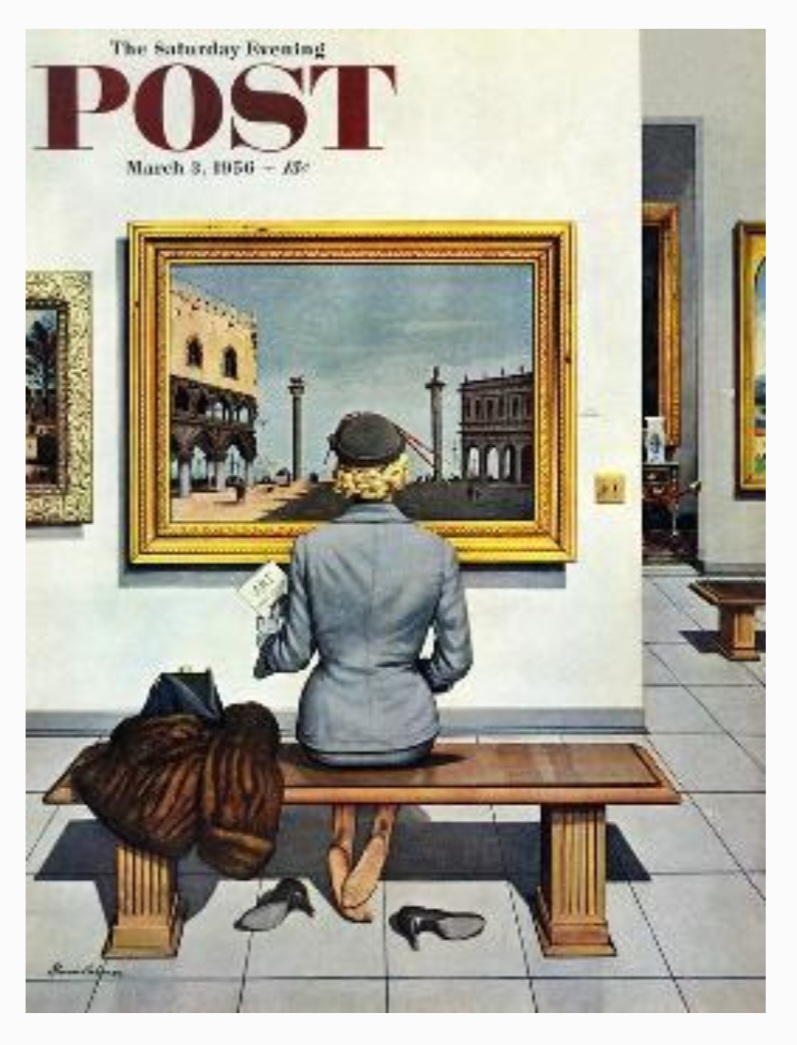
Art Lover
March 3, 1956


Patriotic Band Concert
July 7, 1951


First Cake
May 21, 1955


Puppies For Sale
September 30, 1950


Soda Fountain Dieter
Circa 1954


Stevan Dohanos used Connecticut's people and places as models for his fine art and perhaps most famously, for his cover illustrations for the Saturday Evening Post.  He leveraged lessons learned from his productive art career to help create the Famous Artists School, a commercial art correspondence course managed out of Westport,
Connecticut.  Inspired by the local scene, Dohanos captured a middle-America experience with his realist approach and gentle wit. 

Dohanos grew up as the third of nine children born to Hungarian immigrant parents.  Though factory work enticed them to America, both came from poor, farm-based families.  Starting in his teens, Dohanos worked his way through jobs as a newsboy, floral delivery driver and steel mill worker to help support his family.  When he tranferred to a desk job at the mill, be began copying calendar art and Norman Rockwell covers selling them for $1.00 to $3.00 to other employees. A befitting reward for his own hard work, Dohanos later befriended Rockwell and joined him and 10 other "Founding Artists" to form FAS.  He made his home and kept his studio in Westport, Connecticut.

His first Saturday Evening Post cover was on the March 7, 1942 issue.  It was a well-received wartime image of air raid searchlights from an artillery battery.  


March 7, 1942


Throughout the 1940s and 1950s, the artist's workload for The Saturday Evening Post increased, garnering a contract for roughly a dozen covers a year. During WWII, Dohanos aided the war effort by painting recruitment posters and wall murals for federal buildings.  He also designed stamps for the federal government, starting during the Roosevelt administration and staying in the profession the rest of his life. During his illustrious career, he did film art for the classic movie, White Christmas. 

Stevan Dohano's paintings are in the collections of the Avery Memorial of Hartford, The Cleveland Museum, New Britain Museum of American Art, the Pennsylvania Academy of the Fine Arts and the Whitney Museum of American Art. 

I hope you have enjoyed the many Saturday Evening Post covers by Stevan Dohanos and learning about this illustrator.  


Saturday, April 13, 2024


Stevan Dohanos

(May 18, 1907 - July 4, 1994)


 Palace Theater
Norwalk, Connecticut 


Stevan Dohanos was an American artist and illustrator of the social realism school best known for his Saturday Evening Post covers.  Dohanos was born in Lorain, Ohio and attended the Cleveland School of Art.  In the 1930s he briefly experimented with lithography and wood etching.  He was a member of the National Society of Mural Painters and the Society of Illustrators.  He was a founding faculty member of the Famous Artists School of Westport, Connecticut.  

His first magazine illustration was for McCall's in 1938.  In the early 1940s, he moved to Westport and in 1942 he sold his first cover painting to The Saturday Evening Post.  Dohanos went on to paint over 125 Post covers during the 1940s and 1950s.  He also illustrated for Esquire and other magazines.  In the 1960s he became chairman of the Citizens' Stamp Advisory Committee whih selected art to appear on United States postage stamps.  He selected art for over 300 postage stamps during the administration of seven U.S. Presidents and nine Postmaster Generals.  In 1984, the postal service's Hall of Stamps in Washington was dedicated in his honor.  

Dohanos worked for the Section of Painting and Sculpture of the U.S. Treasury Department, painting several post office murals including those for West Palm Beach,  Florida and Charlotte Amalie U.S. Virgin Islands.  


Dohanos paid his own way to West Palm Beach in 1939 so he could soak up the local color and talk to residents who remembered when mail carriers walked and rowed the 68-mile long route between Palm Beach and Miami.  These mail carriers were called the Barefoot Mailman.  In 1984, he told a Palm Beach reporter he'd hoped his painting of the Barefoot Mailman walking on the beach would one day decorate the corners of envelopes.  He stated "I always thought it would fit into the series on American myths, like Paul Bunyan."

Dohanos' mailman paintings have gone through a couple of changes of address.  Initially designed for the old post office building on Olive Avenue in downtown West Palm Beach, they were moved to the former post office at 801 Clematis Street.  In 1994, the six paintings were peeled off the wall, again and restored by a Sarasota art conservator.  Once revived and framed, they were relocated to the Summit Boulevard facility when it opened in 1985.  The murals depict the legend of James Edward Hamilton, Mail Carrier. Some of the studies of the murals are now in the Smithsonian's American Art Museum.

https://www.seniorlifestyle.com/resources/blog/lantana-palm-beaches-barefoot-mailman/#:~:text=In%201939%2C%20artist%20Stevan%20Dohanos,the%20top%20of%20this%20article).


The Barefoot Mailman is an iconic Florida symbol.  It refers to the carriers on the first U.S. Mail route (1885-1892) between Palm Beach and the settlements around Lake Worth on the north and Miami, Coconut Grove and Lemon City to the south. (Lemon City is known as Little Haiti.  It received its original name from E.H. Harrington who named the area for the lemon trees growing on his property). The mailmen had to walk and travel by boat because there was no road connectings the 68-mile route from Palm Beach to Miami.  Approximately 28 miles of the one-way trip was by rowing different boats and the rest by walking along the firmer sand along the beach.  The route was a Star Route with the carriers contracting with the Post Office.  The route was originally called the "barefoot route" and the carriers were called "beach walkers".  It was not until around 1940 that the term "barefoot mailman" came into use.  


The first barefoot mailman was Edwin Ruthven Bradley, a retired Chicago newsman and Lake Worth, Florida resident.  He and his son, Louie, took turns carrying the mail once a week for about two years.  The third and most famous of the barefoot mailmen was James E. "Ed" Hamilton who had come to Hypoluxo from Cadiz, Kentucky in 1885.  Hamilton became the barefoot route contractor when E.R. Bradley quit in 1887.  Today, there is an upscale bar and restaurant in West Palm Beach bearing the name, E.R. Bradley's Saloon at 104 S. Clematis Street. In the 1970s, it was located in Palm Beach.  

Other men who have been reported as carriers on the barefoot route include George Charter, Bob Douthit, Dan Kelly, Dan McCarley, Frederick Matthaus, Otto Matthaus, Edward "Ned" Peat, George Sears and a man known only as Stafford.  Henry John Burkhardt was the last barefoot mailman.  


Sidenote:  The welcome sign for the town of Hypoluxo, incorporated in 1955, reads "Welcome to Hypoluxo - home of the Barefoot Mailman"